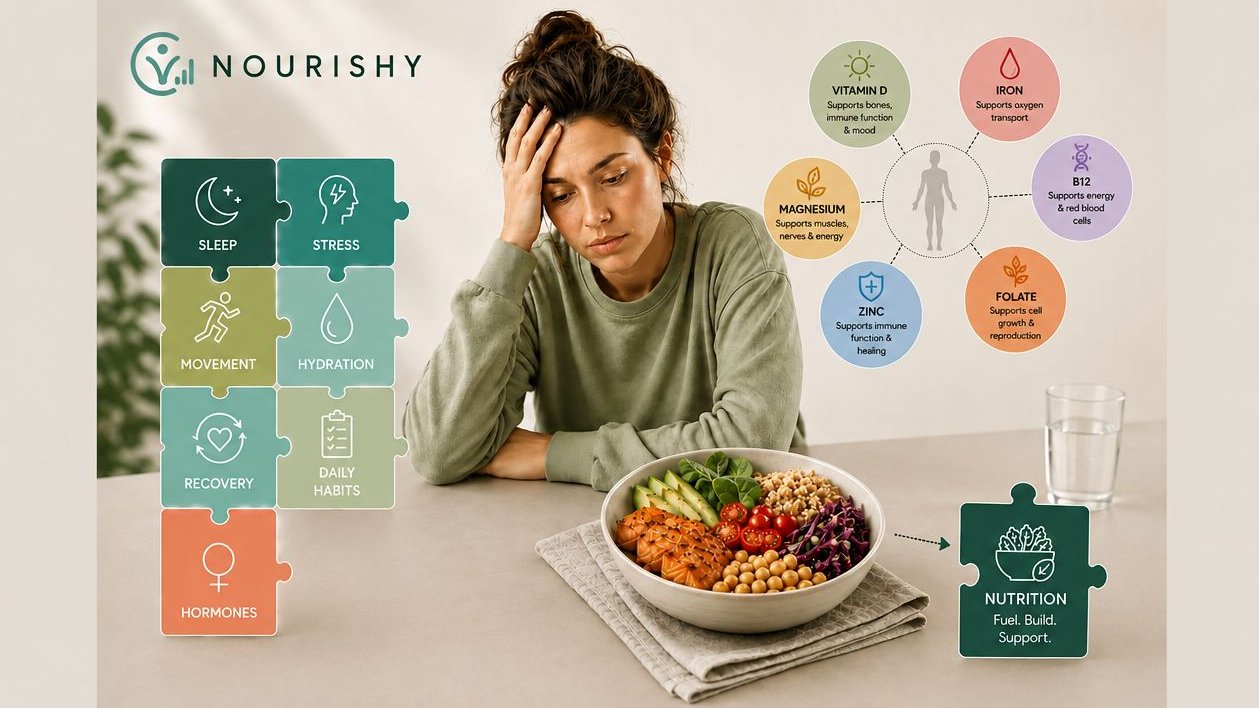
Your body is constantly giving you information. Most of the time, we barely notice it. We eat when we are hungry, drink when we are thirsty and sleep when we are tired. But sometimes something changes. You feel unusually tired, your sleep gets worse, your hair starts shedding, your nails become brittle, your skin changes, or your period becomes irregular or disappears.
Your body is not working against you. These changes are signals that something may be worth looking at. They do not tell you exactly what is wrong, but they give you a reason to pay attention.
There can be many reasons for these changes, and nutrition is only one possibility. Rather than trying to match a symptom to a supplement, it makes more sense to step back and consider the bigger picture. What has changed in your sleep, stress, training, health or diet?
Nutrition is worth looking at because food provides much more than calories. Our bodies need energy, protein, fats, vitamins and minerals to maintain tissues, produce hormones and enzymes, support the immune system, maintain bones and muscles, and keep countless other processes running. A healthy diet needs to provide adequate amounts of these nutrients, although exactly what we need varies from person to person (World Health Organization).
One important example is energy availability. When the body consistently receives less energy than it needs to support both basic functions and physical activity, it has to adapt. In physically active people, prolonged low energy availability can affect multiple body systems, including reproductive function and bone health (Mountjoy et al.). This is one reason that changes in the menstrual cycle can be worth paying attention to rather than simply seeing them as a consequence of dieting or intense training.
Micronutrients can be another part of the picture. We need vitamins and minerals in relatively small amounts, but they are involved in processes throughout the body (World Health Organization). Iron, for example, is needed to transport oxygen. When iron intake is low, the body can draw on its stored iron before a deficiency becomes more obvious, so problems can develop gradually rather than overnight (National Institutes of Health, Office of Dietary Supplements).
This is why looking beyond whether a diet appears “healthy” can be useful. You can eat plenty of vegetables, choose mostly whole foods and avoid highly processed food while still not getting enough energy, enough variety or enough of a particular nutrient. You can eat plenty of protein but very little fibre. You can eat a nutritious diet but not enough to support the amount of exercise you are doing. A diet can look healthy on paper and still not fully meet your individual needs.
This is where looking at what you actually eat can help. We are not always very good at estimating our own intake or remembering everything we eat throughout the day. Portions are easy to underestimate, and small snacks, drinks or ingredients can be easy to forget. What we remember eating is not always the same as what we actually consumed.
By tracking your food over time, you can start to see patterns that are difficult to spot from memory alone. Nourishy translates your food intake into a clearer picture of the nutrients you are getting and where there may be gaps. It does not diagnose a health problem or replace medical advice or testing when those are needed. Instead, it gives you information about one part of the puzzle that is otherwise surprisingly difficult to see.
Your health is rarely explained by one thing. Sleep, stress, hormones, activity, illness, medications, genetics and nutrition can all interact. Nutrition may be a small piece of the puzzle, or it may be an important one. Either way, understanding what you are actually eating is a useful place to start.
Because your body is giving you information all the time. Learning to listen to it is a good place to start.
Ready to understand your nutrition better?
Discover a more personalized way to track, understand, and support your health with the Nourishy App.
Nourishy is coming soon.
— The Nourishy Team
Works Cited
Guo, Emily L., and Rajani Katta. “Diet and Hair Loss: Effects of Nutrient Deficiency and Supplement Use.” Dermatology Practical & Conceptual, vol. 7, no. 1, 2017, pp. 1–10. National Library of Medicine, https://pmc.ncbi.nlm.nih.gov/articles/PMC5315033/.
Mountjoy, Margo, et al. “2023 International Olympic Committee’s (IOC) Consensus Statement on Relative Energy Deficiency in Sport (REDs).” British Journal of Sports Medicine, vol. 57, no. 17, 2023, pp. 1073–1097. https://doi.org/10.1136/bjsports-2023-106994.
National Institutes of Health, Office of Dietary Supplements. “Iron: Fact Sheet for Consumers.” National Institutes of Health, https://ods.od.nih.gov/factsheets/iron-consumer/.
World Health Organization. “Healthy Diet.” World Health Organization, 26 Jan. 2026, https://www.who.int/en/news-room/fact-sheets/detail/healthy-diet.
World Health Organization. “Micronutrients.” World Health Organization, https://www.who.int/health-topics/micronutrients.