The Body We Have Learned to Call "Healthy"
The before-and-after transformation is one of the oldest formulas in the wellness world. We see the body before, the body after, and let the visual difference tell us a story. A smaller waist, more visible muscles, or lower body fat can easily become evidence of "progress," and we naturally assume that looking different must mean feeling healthier too.
But a photograph only shows us what has changed on the outside. It cannot show energy levels, blood pressure, blood glucose, bone health, hormones, nutritional adequacy, sleep, or recovery.
Over time, we have learned to associate looking healthy with being healthy. But they are not the same thing. Weight and body composition can be relevant to health, but they are only part of a much bigger picture. A healthy body is not simply one that looks a certain way. It is one that can function, adapt, recover, and support you in everyday life.
And sometimes, the pursuit of a particular appearance can work against the health we are actually trying to achieve.
When Looking Healthy Starts Costing the Body
Consider what happens when someone wants to become leaner. They eat less and exercise more, and as their body changes, it can feel like everything is moving in the right direction. From the outside, it looks like progress.
But if energy intake becomes too low for the body's needs, problems can develop. Low energy availability occurs when there isn't enough energy left from food to support the body's normal functions after physical activity is taken into account. It can affect athletes, but also teenagers who are still growing, adults dieting while exercising heavily, or anyone who consistently underestimates how much fuel they need.
The effects can extend far beyond feeling hungry. In women, insufficient energy availability can disrupt menstrual cycles and reproductive hormones and, over time, contribute to impaired bone health. In men, it can be associated with reduced testosterone, lower libido, fatigue, and impaired bone health. In both sexes, it can affect recovery, wellbeing, and physical performance (Mountjoy et al.).
What makes this particularly difficult to recognize is that these changes may not be visible. Someone can look increasingly "fit" or lean while their body is struggling to meet its physiological needs.
Getting leaner is not automatically getting healthier.
And our nutritional needs change throughout life. Growing bodies need fuel for development. Active adults need enough energy to support training and recovery. As we age, maintaining muscle and bone becomes increasingly important.
Our bodies change, and our nutritional needs change with them. The rules we see online rarely do.
The Nutrients We Can't See
There is another reason appearance is such a poor measure of nutritional health: you cannot see micronutrients.
You can see muscle definition and changes in weight, but you cannot look at someone and know whether they are getting enough calcium, iron, vitamin B12, vitamin D, or other essential nutrients.
I noticed this myself when I started tracking my nutrition. My calcium intake was consistently too low. I felt fine and had no obvious warning signs, but I wasn't regularly giving my body enough calcium.
Calcium is a good example of why nutrition can be difficult to assess. The body tightly regulates calcium in the blood and can draw on calcium stored in the bones when needed. This means a normal blood calcium level does not necessarily tell you whether your diet is providing enough calcium (National Institutes of Health).
Sometimes, the simplest place to start is to look at what you actually eat.
Instead of asking, "Is this food good or bad?"
I started asking, "What does this food provide, and what does my body need?"
Prevention Starts With Paying Attention
This is where nutrition becomes more interesting than simply counting calories. A nutritional gap does not always produce an immediate symptom. You may not feel different because your diet has been low in calcium for a few weeks or months, and some effects can take much longer to become apparent.
That is why patterns matter. You might rarely eat calcium-rich foods, increase your training without increasing your food intake, or consistently fall short on several nutrients without realizing it. None of these things automatically mean there is a problem, but they are patterns worth noticing.
Good nutrition is not only about reacting when something goes wrong. It is also about paying attention to what you are eating over time and understanding whether your diet is giving your body what it needs.
From Counting Calories to Understanding Nutrition
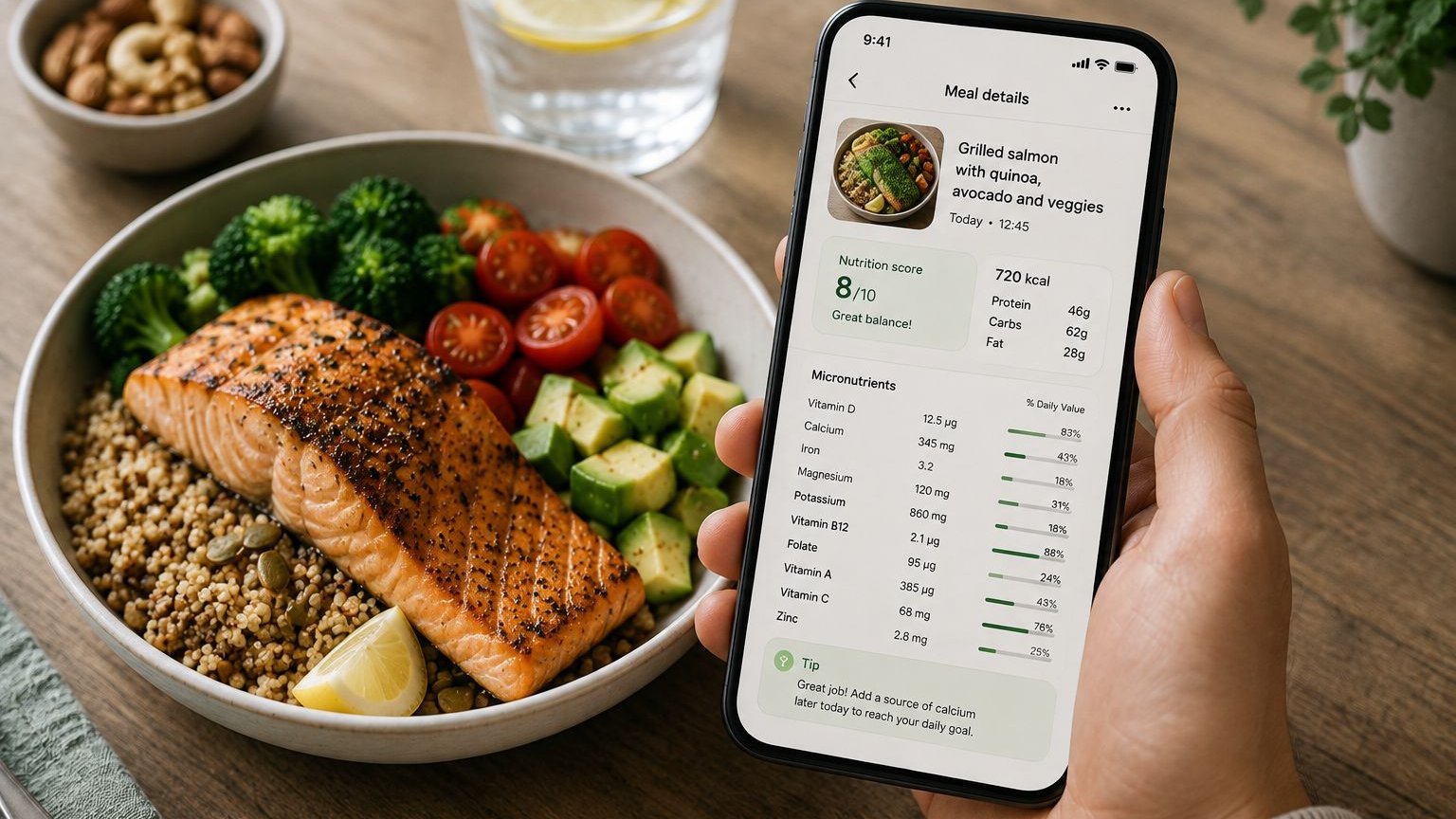
This is where the Nourishy App can make nutrition more visible. Instead of focusing only on calories, Nourishy helps you see the nutrients that are much harder to track in everyday life. By logging what you eat, you can see how your diet contributes to key micronutrients such as calcium, iron, magnesium, potassium, vitamin D, and vitamin B12, alongside other nutritional information.
This matters because nutrient intake is part of the bigger picture of dietary quality. The 2025 Dietary Guidelines Advisory Committee identified several nutrients, including calcium, vitamin D, potassium, and dietary fibre, as nutrients of public health concern because of underconsumption in the U.S. population (Dietary Guidelines Advisory Committee).
Over time, tracking can help you notice patterns you might otherwise miss. You may discover that your calcium intake is consistently low, that you are getting plenty of protein but not much fibre, or that your nutritional intake changes significantly on training days. You might even find that you are eating enough overall while regularly falling short on certain nutrients.
Nourishy does not diagnose deficiencies and is not a replacement for medical testing. Instead, it helps make your dietary patterns more visible, so you can understand your nutrition in a bigger-picture way.
You don't need to obsess over every number. The value is in understanding what you are actually getting from the food you eat.
Because nutrition isn't only about how much you eat. It's also about what you're getting from what you eat.
And sometimes, the most useful thing an app can do isn't tell you what to eliminate.
It helps you notice
Ready to understand your nutrition better?
Discover a more personalized way to track, understand, and support your health with the Nourishy App.
Nourishy is coming soon.
— The Nourishy Team
Works Cited
Dietary Guidelines Advisory Committee. Scientific Report of the 2025 Dietary Guidelines Advisory Committee. U.S. Department of Health and Human Services and U.S. Department of Agriculture, 2025.
https://www.dietaryguidelines.gov/2025-advisory-committee-report
Mountjoy, Margo, et al. "2023 International Olympic Committee's Consensus Statement on Relative Energy Deficiency in Sport (REDs)." British Journal of Sports Medicine, vol. 57, no. 17, 2023, pp. 1073–1098.
https://doi.org/10.1136/bjsports-2023-106994
National Institutes of Health, Office of Dietary Supplements. "Calcium." Office of Dietary Supplements, 11 July 2025.
https://ods.od.nih.gov/factsheets/calcium-HealthProfessional/